A fallen endo sister

March 5th, 2010 steph Posted in Chronic Pain, Endometriosis Awareness, Suicide, news article 4 Comments »

The other day, a fellow endo blogger showed me the story you are about to read below. It affected me deeply, because I have entertained the same thoughts during the past 24-25 years I have suffered with endometriosis. Please read this story. I will be posting more about the topic.

So no one else will suffer
Posted: Thursday, December 10, 2009 1:00 am
By Lisa Fipps managing editor
editor@kokomoperspective.com

Kristi An Rose suffered with endometriosis for 12 years, from 1997 until May 7, 2009 – the day she put a gun to her head and pulled the trigger.

It was a tragic ending of a life that held great promise, a life that is dearly missed, a life that could have been different if more in the medical community knew how debilitating the condition is, knew how much those with it suffer, and knew to take it more seriously, according to her mother, Sherill Rose Hill.

kristi-an-rose_05072009suicide-endo-patient

Nightmare begins

In school, Kristi was very outgoing. After graduating from Northwestern High School, she was a workaholic, said Sherill. Kristi worked several jobs and loved it. She always loved art, especially photography. But at the age of 17, she was already having medical problems.

“Kristi had really bad pains in her abdomen during her periods,” Sherill said. “It wasn’t your typical cramps. It was abnormal. I took her to a couple of doctors. They all said, ‘She’s a teenager trying to get attention.’ That wasn’t Kristi at all. I ended up taking her to Indianapolis to Dr. David McLaughlin of Women’s Specialty Health Centers. He said, ‘I think I know what’s wrong.’ He did a laparoscopy on Feb. 12, 1997. He said she had endometriosis. She was so thrilled to know what was going on because everybody had said she was making it up. She knew she wasn’t.”

Endometriosis “occurs when tissue like that which lines the uterus (tissue called the endometrium) is found outside the uterus – usually in the abdomen on the ovaries, fallopian tubes, and ligaments that support the uterus; the area between the vagina and rectum; the outer surface of the uterus; and the lining of the pelvic cavity,” according to the Endometriosis Association.

According to the Cleveland Clinic, symptoms of endometriosis can include but are not limited to the following:

•extremely painful (or disabling) menstrual cramps; pain may get worse over time

•chronic pelvic pain (includes lower back pain and pelvic pain)

•pain during or after sex

•intestinal pain

•painful bowel movements or painful urination during menstrual periods

•heavy menstrual periods

•premenstrual spotting or bleeding between periods

•infertility

A few months later, Kristi had a microlaser laparotomy to vaporize the endometriosis.

For the first time in years, she felt better. The pain was gone. She was happy. So was Sherill. It’s excruciating to watch your child in such pain, Kristi’s mom said.

But then the endometriosis came back.

“The most recent studies have shown that endometriosis recurs at a rate of 20 to 40 percent within five years following surgery,” according to the Cleveland Clinic.

Kristi’s came back in less than a year. She had another surgery to vaporize more of the tissue. It returned again.

In October 2000, Kristi and Sherill flew to Oregon to see a specialist. That doctor performed an oophorectomy, removing her left ovary. They found out that her fallopian tubes were packed with eggs. The endometriosis had prevented them from dropping down to the uterus monthly. Some would ask why Kristi didn’t have a hysterectomy. Doctors were hesitant to do that considering how young she was, Sherill said.

Besides, a hysterectomy is not a cure. Currently, there is no cure for endometriosis. Even having a hysterectomy or removing the ovaries does not guarantee that the endometriosis areas and/or the symptoms of endometriosis will not come back.

After the surgery in Oregon, Kristi was still in pain. “That was a big let down,” Sherill said. “We thought it would be great. We thought it’d be all over.”

Kristi was in constant pain. Her mom searched the Internet trying to find someone who could help. In 2003, Kristi and Sherill headed to Birmingham, Ala., to see a specialist at the Chronic Pelvic Pain Treatment Center.

“When we drove there, we had big hopes,” Sherill said. “By the time we walked out of there, they’d diagnosed her with five different problems – all related to endometriosis.”

Severe pelvic congestive syndrome, vulvar vestibulitis, pelvic floor myalgia, irritable bowel syndrome, and abdominal wall trigger points.

Kristi also suffered from severe interstitial fibrosis of the bladder with chronic interstitial cystitis, a condition that results in recurring discomfort or pain in the bladder and the surrounding pelvic region.

The autopsy report gives a glimpse of just have pervasive the endometriosis was in Kristi’s body. It was on her liver. It was on her bowels. It was on her right kidney. Her right ovary had multiple cysts with large “chocolate cysts” (cysts that form when endometrial tissue invades an ovary), including one that had ruptured right before her death. Her fallopian tubes and right ovary had adhered to her uterus and pelvic wall. There were multiple fibrous pelvic adhesions.

“The doctor who did the autopsy said she had more endometriosis than anyone he’d ever seen,” Sherill said.

To say she was in pain is an understatement.

Kristi gave up. She was tired of doctors. She was tired of hospitals. She was tired of the pain.

In 2006, Sherill’s husband, Kristi’s stepfather, Mike Hill, developed cancer. Sherill was torn between helping her daughter who was suffering and her husband who was suffering.

“I told her, ‘We’re going to find something for you,’ ” Sherill said. She pleaded with her daughter to hang in there until they found someone who could help. By then Kristi had no insurance. Her mom and stepdad helped pay for her medical expenses. Kristi hated that. She was independent. She wanted to take care of herself.

On April 16, 2009, Mike Hill died.

“Kristi said, ‘Look at him. He’s at peace. I would love to be at peace,” Sherill said.

She began to worry about her daughter. She was sinking deeper and deeper into depression. A letter Kristi wrote on April 4 details her thoughts: “I am so tired of the pain. It is enough to drive someone crazy. Having constant pain all the time is enough to want to give up. Enough to want to put my fragile body to rest. My body can’t take any more. My brain is past the breaking point. My heart is broken. God, my heart is broken.”

“She was having grand mal seizures and pretty much bed-ridden then,” Sherill said of her daughter. “I got an uneasy feeling,” Sherill said. “So I hid the gun we kept in the house. Three days prior to her dying, she said, ‘I don’t want this anymore. They can’t fix me.’ I begged her. I said, ‘Please, let me see what I can find out. We’ll find something. She said no. ‘You’re not going to take me to another doctor, who will just take your money and say, ‘Well, we don’t know what else to do for her.’ ”

On May 7, 2009, Sherill was on her way home from a short trip to Kentucky and called her daughter.

“I told her I was almost home,” Sherill said, tears flowing down her cheeks. “She said, ‘I want you to remember one thing.’ I said, ‘What?’ She said, ‘I love you very, very, very, very, very, very, very, very, very, very much, Mom, and she just kept saying it. And I said I love you very, very, very much, too.’ ”

As Sherill drove home, Kristi searched the house and found the gun. She went outside to the back yard. She put the gun to her head. She pulled the trigger.

“When I got home, the police were in the yard,” Sherill said, sobbing. “I couldn’t pull into the driveway. My son, Tom, was there. I have another son, Michael. Tom had been in the house, and the neighbors came and got him. They said, ‘Your sister’s lying in the backyard.’ My son went out and got her. That’s just been very hard for him. He said, ‘I held her and she wasn’t talking.’ He said he kept thinking, ‘I gotta get this fixed before mom gets home.’ When I pulled up in the yard, as soon as I got out of the car, Tom grabbed a hold of me so tightly I could hardly breathe. He said, ‘Kristi shot herself.’ He held me so tight and he wouldn’t let go. I said, ‘Is she alive?’ He said, ‘Yes. They’re trying to get her stable.’ They wouldn’t let me go to the back yard. It seemed like forever and then they brought her to the front and put her in the ambulance. I yelled at her to fight like hell, and then we were on our way to the hospital. It wasn’t very long before they came out and said she didn’t make it. I said, ‘Can I see her?’ They let me see her, and when I looked at her I knew it was over for her. She suffered so much pain. Pain was a daily thing. The doctors didn’t take it as seriously as they could or should have.”

There was no funeral. Kristi had always said she wanted to be cremated. “I was with her every step of the way, I wasn’t going to let her go through that by herself,” Sherill said. “I’m not going to let her down now. I went down to Greenwood where they do it. I kissed her. I talked to her and then I watched as they took care of her.”

Sherill broke down in tears.

Her daughter killed herself 20 days after her husband died. Twenty days after her daughter’s suicide, Sherill had a dream. In it, Kristi was smiling, running, happy, free.

“That’s the one thing that’s kept me going because I know she’s not in pain anymore,” Sherill said, crying. “I’m just crying for myself now. I’m just so lonely I don’t know what to do with myself. I just don’t know what to do.”

What she has done, with her from her two sons, is have a fundraiser in Kristi’s memory, with the proceeds going to the Endometriosis Research Center.

“I wanted to help somebody else,” Sherill said. “So no one else has to live that way. I just want everybody to know how much pain she went through, how much she suffered, so this doesn’t happen to anybody else.”

To contact Sherill about the fundraiser, send an e-mail to endokristi [at] yahoo [dot] com.

AddThis Social Bookmark Button

1 in 10 women have endometriosis worldwide

February 26th, 2010 steph Posted in Endometriosis Awareness No Comments »

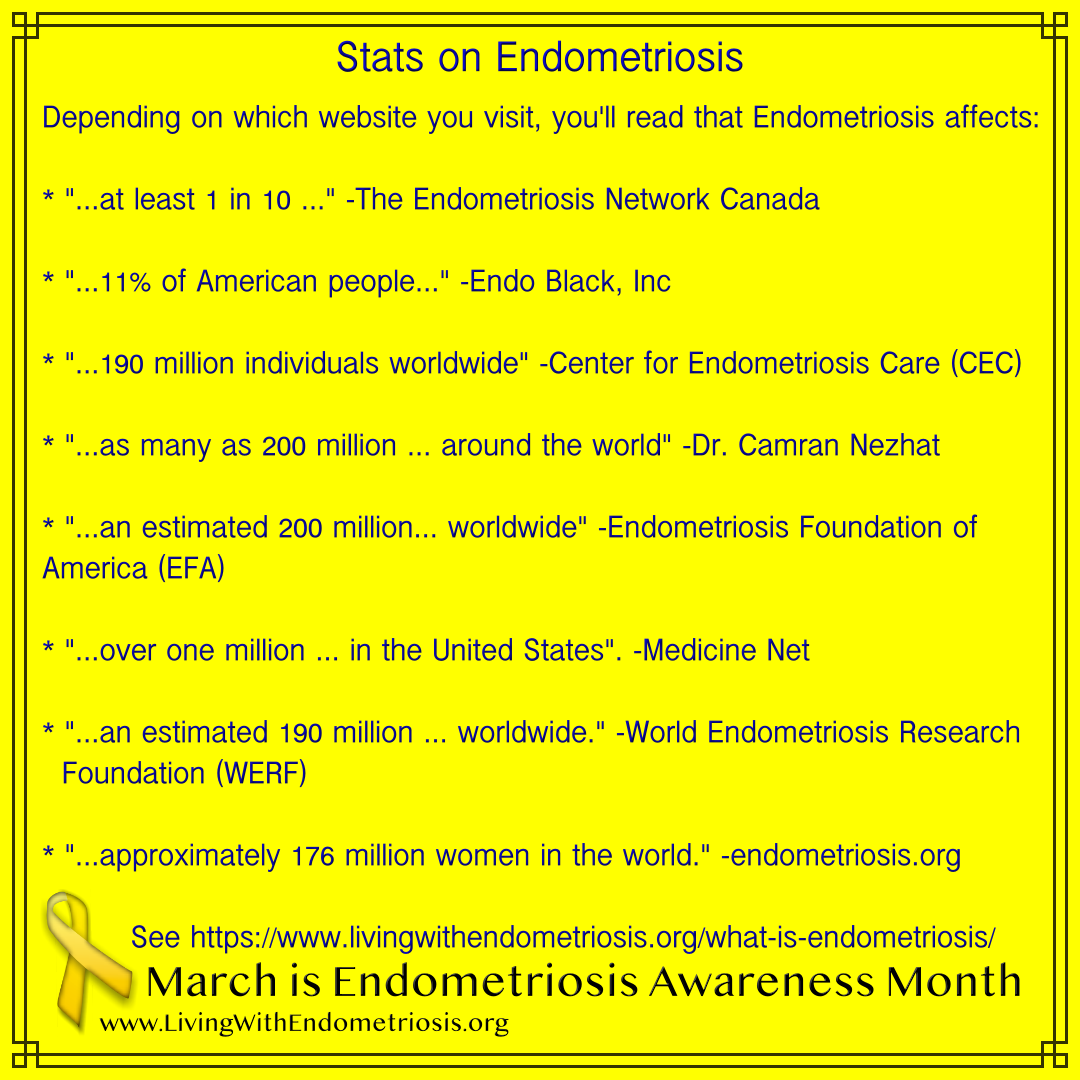
Did you know? 1 in 10 women worldwide suffer from endometriosis. Click the image below to see what it is like to live with endometriosis.

Click here for a theme song to go with the photo gallery. Personally, I like the UB40 and 808 State remix.

AddThis Social Bookmark Button

Family Enters NASCAR Race to Raise Endometriosis Awareness

February 25th, 2010 steph Posted in Endometriosis Awareness, news article No Comments »

Salina Family Enters NASCAR Race to Raise Endometriosis Awareness
Posted: Feb 25, 2010 3:36 PM
(SALINA, Kan.)

A Salina teen is diagnosed with a disease that causes extreme chronic pain. Endometriosis affects millions of women each year, but the cause is still a mystery. Now one family hopes to raise awareness.

Shellby Humbargar is a junior in high school and loves playing the drums.

“I just turned 17,” she said.

When she was 14 she started having severe pain in her back and sides.

“It hurts like you can’t describe,” Shellby said.

Just six months ago, she was diagnosed with endometriosis; a disease that creates lesions on the inside of the body and causes extreme chronic pain.

“It sucks. One day your fine and the next you can’t get out of bed because it hurts so bad,” she said.

But the pain isn’t just physical. Shellby says the disease has really taken a toll mentally, especially on her school and social life.

“There’s already enough drama in high school, I don’t need any more. Some of my relationships have gotten stronger, but some have just disappeared,” Shellby said.

There’s no cure for Shellby’s disease. Her mother has had to sit by and watch as Shellby suffers.

“Other than medications there’s not a lot you can do,” said Debbie Beamen, Shellby’s mom..

So Debbie took matters into her own hands. After seeing a NASCAR contest advertised on TV, she decided to design a race car in Shellby’s honor, in hopes of bringing awareness to the disease that has caused her daughter so much pain.

“If there is any way I can help people understand and raise awareness about this disease then I’m going to do it.” she said.

There are hundreds of car designs, but Shellby’s is the only one of its kind.

“The yellow is the official color of endometriosis, and the pink splotches represent the lesions that are inside her body causing the pain,” Debbie said.

People can vote for their favorite car online. The winning design will actually be put on a race car.

“We may not have the best car, but we want people to vote so that endometriosis can be out in the public eye,” said Debbie.

“If we don’t take a stand and raise awareness about this, who will?” asks Shellby.

This is where you can vote for Shellby’s car:
http://www.sponsafier.com/#/gallery/view/8784

AddThis Social Bookmark Button

Endometriosis, the life-wrecker doctors dismiss as period pain

February 23rd, 2010 steph Posted in Endometriosis Awareness, news article No Comments »

Endometriosis, the life-wrecker doctors dismiss as period pain
By Caitlin Davies - dailymail.co.uk
Last updated at 11:29 PM on 15th February 2010

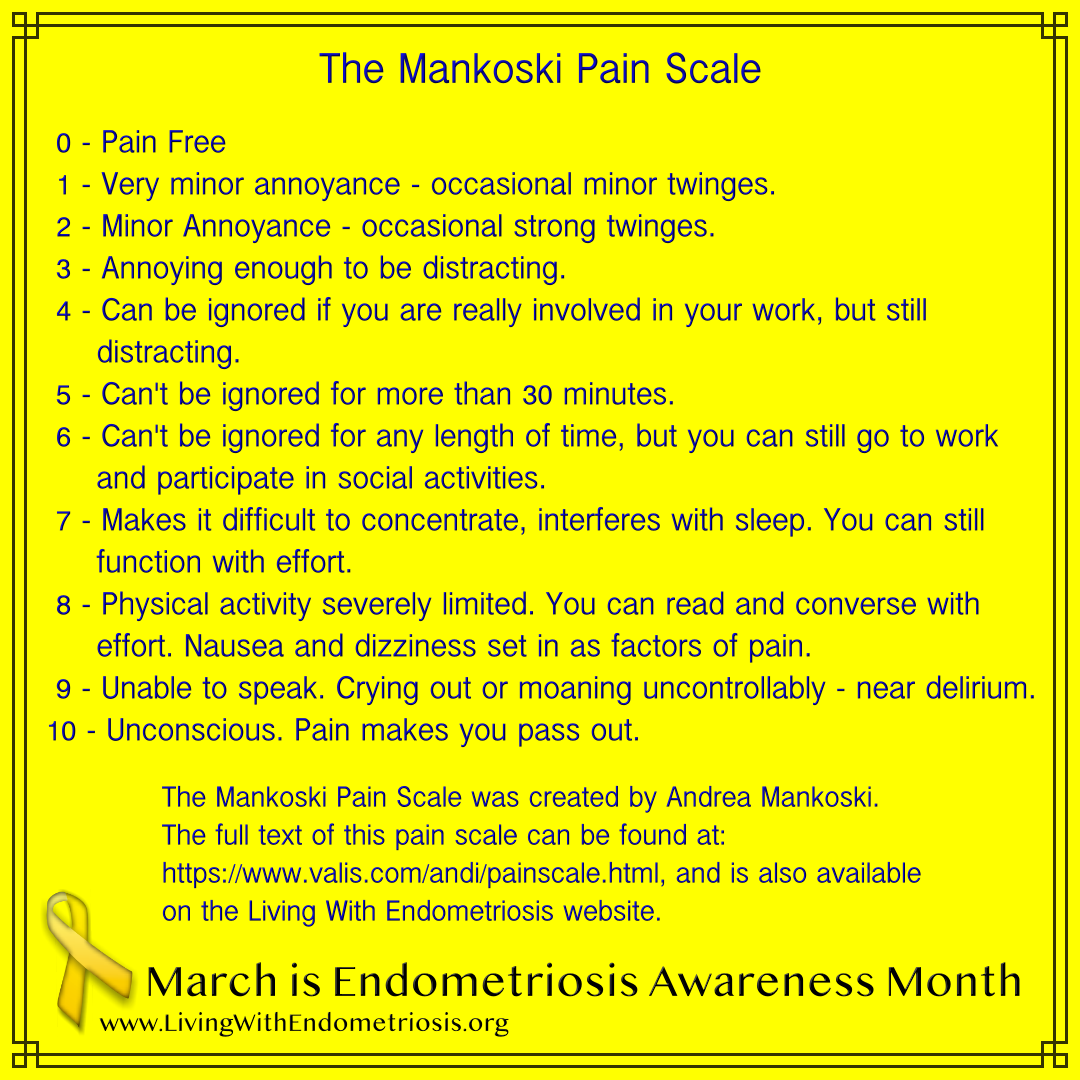
Sometimes the pain was so bad Ruth Forwood, then aged just 12, would nearly pass out.

‘It felt like someone was stabbing me inside,’ she recalls. When she was 13, she went to her (female) GP and was told this pain was ‘part of being a woman’ and to learn to ‘get on with it’.

‘At times I was unable to concentrate or function, and I often missed school,’ Ruth says. Over the next ten years she took painkillers, used heat-patches and hot water bottles and did breathing exercises in order to try to cope.

Then, just over a year ago, Ruth, now 23, was looking up her symptoms on the internet and up popped the word ‘endometriosis’.

The condition is caused when cells like the ones found in the lining of the womb grow elsewhere in the body, most commonly inside the pelvis and around the ovaries. It’s not known why this happens.

During the monthly cycle, hormones stimulate these cells, causing them to grow, break down and bleed. Depending on where the cells are, this can lead to heavy and agonising periods.

If the rogue cells have no way of leaving the body, this can trigger pain, inflammation and the formation of scar tissue and cysts.

In some cases, the affected organs, such as the ovaries and the nearby bowel, stick together, causing chronic pain and bowel symptoms. Women can suffer bladder problems, and sex can be uncomfortable too. Endometriosis can also cause infertility.

An estimated two million women and girls in Britain suffer from the condition, but a huge number - nearly 70 per cent of these women - are misdiagnosed, according to the National Endometriosis Society. They’re often told they have irritable bowel syndrome, or ‘psychological pain’, suggesting it’s all in the mind.

It takes, on average, eight years from first seeing a GP to getting a proper diagnosis, says the charity. And in the meantime, for many women, life simply falls apart.

‘I felt a sickening dread when I read about endometriosis as all my symptoms fell into place,’ says Ruth, a university student from Uxbridge, Middlesex. ‘Right then I just knew I had it.’

She had only vaguely heard of the condition before, and could hardly fathom that her years of problems had implications for her fertility.

She’d planned to become a teacher, then eventually start a family but ’suddenly my future seemed in jeopardy’. Ruth went to her GP, but once again she was told period pain was ‘normal’ and that she was ‘too young’ to have endometriosis, which is still regarded as a disease affecting women in their 30s and 40s.

But she was insistent, so her GP referred her to a gynaecologist two months later.

‘I didn’t want to wait that long,so I decided to see a consultant privately,’ says Ruth.
He suggested she had a ‘hormone imbalance’, and after an internal scan, which was clear, said he was 99per cent certain she didn’t have endometriosis. She left in tears.

She then saw the NHS consultant who told her to come back if she was ‘in constant agony’ after six months.

‘I was so fed up that my parents paid for a private appointment with an endometriosis specialist, Simon Butler-Manuel, at the Guildford Nuffield Hospital in Surrey.

‘He said it was not the first time he’d seen someone in my situation or who had been fobbed off with IBS or being too young.’

A laparoscopy - where a tiny camera is passed into the pelvis - confirmed she did have endometriosis.

This is the only way to make a definite diagnosis of the condition, says the Royal College of Obstetricians and Gynaecologists (the technique can also be used to remove or destroy the rogue cells - there is no other treatment).

However lots of women are put off having a laparoscopy by their GP or consultants, according to Philip Kaloo, a spokesman for the Royal College.

‘They are wary that the procedure might not find any endometriosis. But I see that as reassuring for the woman to know, and if it is endometriosis then it makes sense to treat it early on.’

Mr Kaloo says late diagnosis is partly due to the fact that symptoms such as period pain or pain during intercourse are relatively common. ‘Women are told it’s normal by their friends, so they think, what’s the point in pursuing it?’

He says research shows endometriosis can be effectively treated surgically in up to 60 per cent of patients, with a significant reduction in pain, even after five years. And because endometriosis can affect fertility, it’s a good idea to get it treated, says Chris Mann, a laparoscopic surgeon at the Royal Wolverhampton Hospitals NHS Trust.

However, surgery is not a cure - endometriosis can keep growing and in many women it will come back. But it will improve a woman’s chance of conceiving, giving her a window of time before this happens.

When Ruth underwent surgery - which cost her nearly £4,000 - she was found to have ‘extensive endometriosis’ throughout her pelvis, as well as two cysts filled with old blood. These were removed and the endometriosis lasered away.

‘I’m gutted that I had to pay so much, but I can hopefully keep it from growing back by being on the Pill,’ she says. Contraception can help by reducing or stopping menstruation, keeping the condition under control.

‘I’ve been told my Fallopian tubes and ovaries are healthy, but endometriosis might still affect my fertility as it can release a chemical which kills sperm.’

Mr Kaloo advises anyone who suspects they have endometriosis to ask their GP to be referred for a laparoscopy, and to see an endometriosis specialist.

But this is easier said than done, as Anya Reid knows all too well. In June 2005, she should have been celebrating her 33rd birthday. Instead she was in hospital with severe constipation, having not been to the toilet for three weeks.

Anya had already suffered two years of pain and bloating, which her doctor had told her was IBS and she would have to learn to live with it.

She had taken laxatives and changed her diet, eliminating wheat, then sugar, yeast, caffeine and dairy, all thought to aggravate IBS symptoms. But this didn’t help. Then her periods became heavier, lasting two-and-a-half weeks. Sex became unbearably painful.

‘I knew this wasn’t right. I didn’t think it was my bowels that were the problem.’
up in hospital was the turning point. Despite the severe pain, she simply had her heartbeat checked and was sent home.

‘I went back to my doctor’s and completely lost my temper. The pain was affecting my relationship, my work as a photographer, and my sanity. If it was IBS, then why didn’t anything help?’

Anya had a colonoscopy to see if any obstruction might be causing the constipation, but this was clear.

Still the pain continued. Then, just like Ruth, early last year she was on the internet when she stumbled across an endometriosis website. ‘It was like a light bulb switched on. All the symptoms I’d been suffering from for nearly six years were there in front of me.’

After seeing her GP, who diagnosed an ‘enlarged’ uterus, and two gynaecologists, who diagnosed IBS, a radiographer spotted a cyst typical of the condition and she was referred to a third consultant. She was finally diagnosed with endometriosis in January.

Chris Mann’s patients have, on average, already seen three consultants before he diagnoses them with endometriosis, he says. ‘Lives are being blighted. How can women be left to suffer pain for years?’

It is worse for Anya, who’s now been told she will be unable to have children. ‘This makes me very sad, as I would have liked to have a child,’ she says.

She was planning to marry in April, but has had to postpone it as she is not fit enough to enjoy the day and gets tired quickly.

‘I’m angry that I’ve had so many years of misdiagnosis by many different doctors. I’m pleased that I was right about endometriosis and it not being just IBS, but that’s not much consolation really.’

AddThis Social Bookmark Button

Woman to jump from plane for endometriosis awareness!

February 20th, 2010 steph Posted in Endometriosis Awareness, news article No Comments »

Would you jump 10,000 feet from an airplane to call attention to an incurable illness?

That’s exactly what Abigail Smith will be doing on March 13, 2010! Abigail has endometriosis, an excruciating condition whereby the lining of the uterus travels and embeds in surrounding organs. The illness, although not a cancer, behaves like one. Doctors don’t know for sure what causes it, and they haven’t yet found a cure. Oftentimes, treatments of this condition are worse than the condition itself, and many endometriosis patients have said that they feel like human guinea pigs.

Back to Abigail! I found out about her story while going through my Google Alert emails; I have one set for ‘endometriosis’, and Abigail’s story popped up.

Abigail is 17-years old, and lives in Evesham, Worcestershire, United Kingdom. In November, 2009, she was diagnosed with endometriosis via laparoscopy. Since that time, Abigail has been researching possible causes for endometriosis, and also reading up on what she can do to manage the illness. It was during her web searches that she found the website Endometriosis Uk and read about the The BIG Jump for endometriosis awareness in March 2010.
In fact, March is endometriosis awareness month around the globe!

I was alarmed when I clicked through to Abigail’s donation page and saw the following:

Target: £400.00
Raised so far: £0.00

I made a donation and I would love for you to donate, too. Abigail needs your love - please support her Big Jump!

According to Evesham Journal, “Abigail’s jump is scheduled to take place from Brackley Airfield, near Oxford, on March 13.”
To add you support, go to http://www.justgiving.com/Abigail-Smith.

If you would like further information about the sponsor, Endometriosis UK, please visit endometriosis-uk.org.

Abigail isn’t the only brave soul willing to leap out of a plane for endometriosis. You can read more stories of skydivers for endometriosis at http://www.endometriosis-uk.org/getinvolved/fundraising_events/blogs.html!

AddThis Social Bookmark Button

On behalf of everyone in the U.S. who suffers with endometriosis…

September 9th, 2009 steph Posted in Endometriosis Awareness 1 Comment »

I was born with an incurable autoimmune disease that runs in families. It is called endometriosis. It behaves like a cancer. It causes pain so severe I have vomited. I have collapsed. I have gone to the emergency room. There is no guarantee of pain relief with meds, HRT, surgery, hysterectomy, pregnancy, child birth, or menopause. Doctors don’t know the cause, and they don’t have a cure. I NEED health care to work FOR me. Support health care reform.

Check out the text of President Obama’s health care reform speech, given earlier tonight.

Hi, my name is Steph. I maintain the Living With Endometriosis blog. Thanks for reading.

AddThis Social Bookmark Button

Endometriosis symptoms often ignored

April 3rd, 2009 admin Posted in Endometriosis Awareness, news article 5 Comments »

Although I strongly object to the use of Lupron to treat Endometriosis, I wanted to share this news story anyway because I am happy to see Endo being talked about in the news. The more often it’s talked about, the better the eventual likelihood that people will acknowledge this illness and treat women who have it with more respect and compassion.

Endometriosis symptoms often ignored
Endo is in top causes of infertility in women
Updated: Thursday, 26 Mar 2009, 6:58 PM EDT
Published : Thursday, 26 Mar 2009, 4:08 PM EDT

Alyssa Ivanson

FORT WAYNE, Ind. (WANE) - Anywhere from two to ten percent of reproductive age women have a condition called endometriosis, according to the National Institutes of Health.

The U.S. Department of Health and Human Services cites around 5 million women in the United States have endometriosis, also known as endo, making it one of the most common health problems for women.

Endometriosis is when menstrual tissue that’s supposed to be in the uterus gets inside the body cavity.

“It has its own period every month and that’s what causes pain because it shouldn’t be inside. It should be coming out,” Dr. Geoffrey Cly from Northeast OB/Gyn said. “The [endo] cells get into [the body tissue] and it swells and trys to have a period. It causes a blister inside on those surfaces.”

If left untreated, endo can cause infertility, and is a leading cause of women infertility. Many women live with symptoms for years before seeing a doctor, including me.

It wasn’t until I had a painful bump on my belly button for more than a year that I went to see a doctor about it. Dr. Cly thought it looked like endo had started growing in my belly button, but the only way to know for sure was to have surgery.

“You had endo up much higher than most endometriosis,” Dr. Cly said.

It didn’t take long in surgery for Dr. Cly to know I did in fact have endometriosis, and a biopsy of the cells confirmed it. I had endo growing on my abdominal wall and bowel. Luckily, I didn’t have any on my tubes or uterus, so I should be able to have a family one day.

“It was nice [that is showed up in your belly button] in a way because we were able to get in and get it early so there isn’t any major damage,” Dr. Cly said. “Without that sign, you may have not known for a while and there might have been damage on the tubes or overies.”

Now I am controlling my endo with hormone shots and birth control to keep it from growing back too quickly.

“The best thing now is to stay on top of it. Depo Lupron treats it and knocks it out, and then we’ll limit periods after the Lupron wears off,” Dr. Cly said.

My endo will grow back eventually. There is no cure. You can only try to control it. Dr. Cly said I should have children in the next few years… to that I say… “I’m getting married in October first! Then we’ll see.”

“Start thinking of moving in the direction of having a family sooner instead of waiting three to five years because that gives the endo more time to try to cause more problems,” Dr. Cly said.

I chose to share my story because when I was going through my diagnosis I found many women didn’t know what endometriosis was. It is a common women’s health issue and because it can lead to infertility if not treated early, I felt it was important to help educate men and women by talking about my experience.

Feel free to ask me questions. Send me an email or message me on Twitter!

AddThis Social Bookmark Button

Fact or Myth? Endometriosis is caused by a sexually transmitted disease (STD).

March 29th, 2009 steph Posted in Endometriosis Awareness No Comments »

MYTH!!

“I have been asked that, and I know that a few other people on here bave been asked the same thing”. - Samantha on an endo forum on facebook.

I too have been told by a gynecologist that I must have a STD, because he was sure I didn’t have endometriosis. This, after a referral from another doctor. All he did was give me a pelvic exam, and state definitively he did not believe I have endo. He even suggested I may have recurrent bladder infections, but not endo.

Dr. David Redwine, a notable endometriosis specialist and surgeon, writes:

“In medical school, many doctors are taught that sexually transmitted diseases (STD’s) are rampant because of sexually promiscuous women. This is clearly a simplistic and sexist viewpoint, but it is commonly encountered during the initial evaluation of pelvic pain. Even when a teenager may give a history of being a virgin, she may be subjected to testing for and antibiotic treatment of presumed STD’s. Sometimes the patient may be admitted to the hospital for intravenous antibiotic therapy.

“Since the severe pain usually lets up after some time, the conclusions are made that the patient is responding to medication and that she really did have an STD despite negative cultures. Some patients undergo repeated rounds of antibiotic treatment before STD’s are discarded as the cause of the pain.

“Frequently birth control pills are prescribed. Although these may be very helpful in controlling symptoms for some patients, there is no medicine that eradicates endometriosis.”

AddThis Social Bookmark Button

Fact or Myth? If you are a redhead, you are more likely to have endometriosis.

March 28th, 2009 steph Posted in Endometriosis Awareness No Comments »

This one is tricky…. the answer is both ‘fact and myth’, but do read on…

witchiepo on DailyStrength.org, a redhead, says she was told “if you are a red head and have freckles you will have endo”.

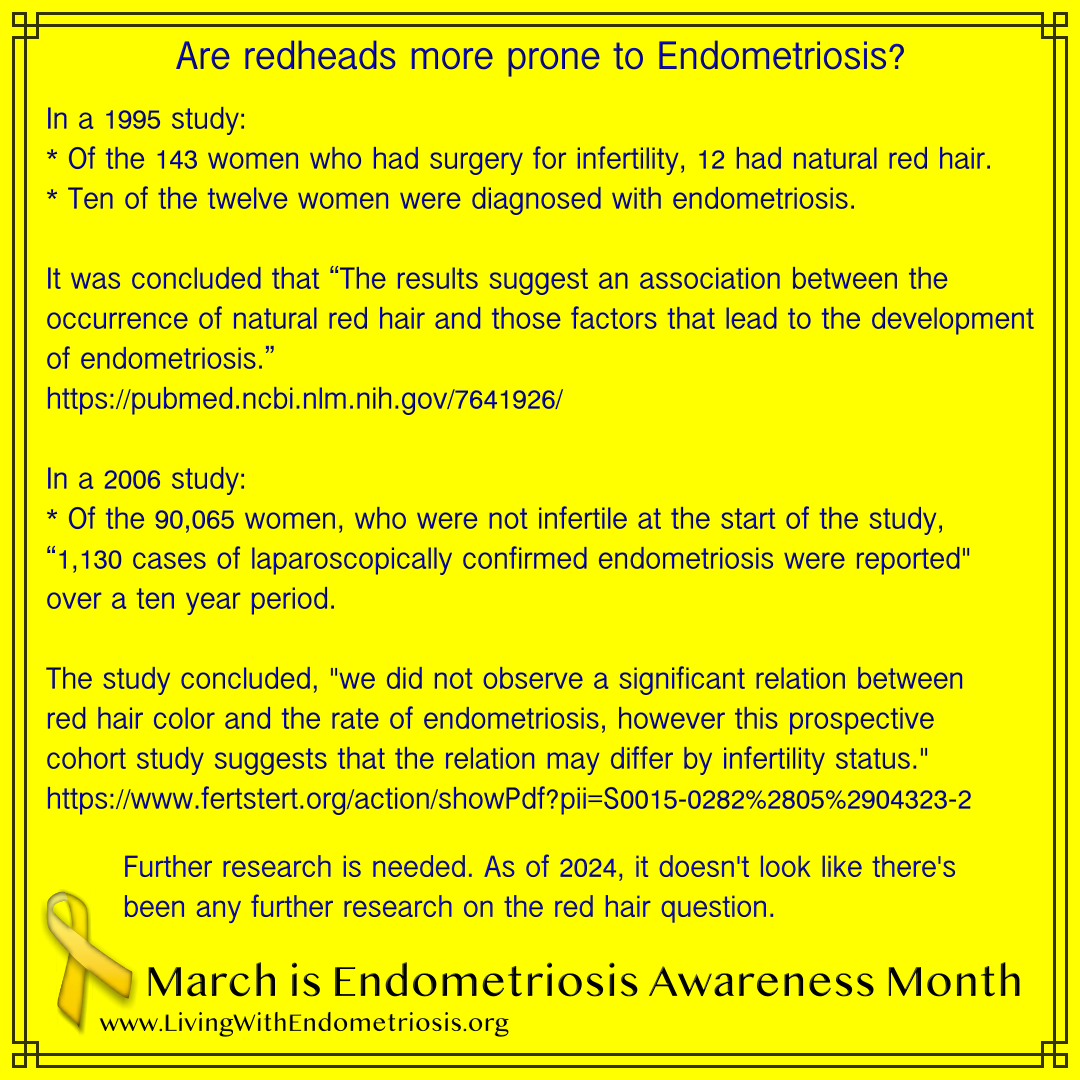
Back in 1995, there was a study to determine whether infertile red-headed women have an increased predisposition towards endometriosis. They studied 143 women having laparoscopy and laparotomy for infertility. Of the 143 women who had the surgery, 12 had natural red hair, and 10 of those 12 women were found to have endometriosis. That’s 83% of the redheaded population in that study.
In contrast, only 55 out of 131 non redheaded women (42%) were found to have endometriosis. So, in that study in 1995, it was concluded that “The results suggest an association between the occurrence of natural red hair and those factors that lead to the development of endometriosis.”

One year later, another study came out, to reopen that case and study it again. In this much larger study, 90,065 women, “who had never been diagnosed with endometriosis, infertility, or cancer” made up the baseline and were followed for the next ten years. The study was published in 2006, showing that in those ten years, “1,130 cases of laparoscopically confirmed endometriosis were reported among women with no past infertility.”

According to endometriosis.org, who reported on the study:

“Red hair colour was not tied to endometriosis in the overall analysis, which accounted for a variety of factors, such as parity (the number of times a woman has given birth) and body mass index. However, there was a suggestion that red hair colour slightly increased the risk of endometriosis among women who had never been infertile, but decreased the risk among those who were infertile.

“Further investigation into the potential linkage between red hair colour and coagulation or immune dysfunction may explain the observed difference in the association between hair colour and endometriosis with concurrent infertility vs. endometriosis without infertility,” the authors conclude.”

AddThis Social Bookmark Button

Fact or Myth? Surgeons will tell you that Endometriosis can be found in unlikely places such the lungs, just to scare you into getting surgery.

March 27th, 2009 steph Posted in Endometriosis Awareness 1 Comment »

Myth!

Endometriosis HAS actually been found in the lungs! It is still considered uncommon, but there is research dating to the 1960s to prove that endometriosis does in fact occur in the lungs.

Dr. Joseph W. Krotec and RN Sharon Perkins write in Endometriosis for Dummies:

“Diagnosing endometriosis in the lungs, or thoracic endometriosis, requires an inquiring mind. Even if you know you have endometriosis elsewhere, you may think that relating it to your lung problems is too far fetched. Thoracic endometriosis can cause many different symptoms, all seemingly unrelated to your pelvis. But suspecting thoracic endometriosis is the first step to diagnosing it, and you may be more likely to make the connection than your doctor, especially after reading this book.” (Read more on pages 110-112).

See also the Ask Dr. Cook Archives, from notable endometriosis specialist and surgeon Dr. Andrew Cook, whereby he addresses the endo in the lungs question.

AddThis Social Bookmark Button