Living With Endometriosis

  • [Home]
  • [About]
  • [What Is Endometriosis?]
  • [Support]
  • [Endo Organisations]

18

Apr

What Is Endometriosis?

Posted by steph 

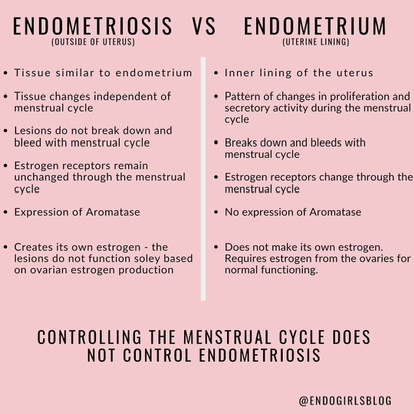
Endometriosis is a currently non-curable autoimmune illness that women are born with, which affects the lining of the uterus (the endometrium). Doctors do not know what causes endometriosis – there may be several causes. The most frequently talked about causes of endometriosis are the retrograde menstruation theory, surgical transplantation of the disease, and pesticides such as dioxin (Read more about these theories at the Endometriosis Association and National Institute of Health websites).

Pieces of the endometrium end up outside of the uterus, and are found on surrounding organs, such as the ovaries, fallopian tubes, intestines, pancreas, bladder, and anywhere in the abdominal cavity.

At onset of menstruation, these pieces of endometrium receive the same hormonal signal that the lining of the uterus does – and these pieces begin to break down and bleed like the lining of the uterus does.
This in turn sets off the alarm (read: pain receptors) on the surfaces to which these rogue pieces of endometrial lining are attached, and widespread inflammation, as well as an immune response, is triggered.

This often leaves a young girl or woman in pain so serious that she can vomit, pass out, and/or require a trip to the hospital. Interestingly enough, some women with endometriosis do not experience debilitating pain.

The symptoms of endometriosis vary from woman to woman, but often include the following:

  • Chronic pelvic pain, often extending to the lower back
  • Heavy menstrual cycles
  • Mittelschmerz (mid-cycle pain and/or bleeding)
  • Pain during intercourse
  • Moderate to severe fatigue
  • Painful urination or bladder complications during menstruation
  • Painful bowel movements during menstruation
  • Rectal bleeding before and/or during menstruation
  • Diarrhea, constipation or nausea during menstruation
  • Frequent Urinary Tract Infections and/or yeast infections
  • Infertility
  • Low-grade fever
  • Migraine headaches
  • Nausea
  • Dizziness
  • Hypoglycemia (low blood sugar)-like symptoms
  • Joint pain
  • Feeling out of breath or easily winded

 
Stats are still sketchy as to how many women suffer with endometriosis:

  • “6.3 million women and girls in the U.S., 1 million in Canada, and millions more worldwide”. – Endometriosis Association

  • “Current estimates place the number of women with endometriosis between 2 percent and 10 percent of women of reproductive age. But, it’s important to note that these are only estimates, and that such statistics can vary widely”. – National Institutes of Health
  • “Endometriosis is a chronic disease of a woman’s or teenage girl’s reproductive and immune systems found in 2-4% of the general female population worldwide”. -Endo Magazine
  • “Endometriosis is a very common condition affecting up to 10 per cent of women between 16 and 50 years of age, often without producing any symptoms”. -Net Doctor
  • “Endometriosis is typically seen during the reproductive years; it has been estimated that it occurs in roughly 5% to 10% of women”. – Wikipedia, citing October 15, 1999 American Academy of Family Physicians information.
  • “Endometriosis is estimated to affect over one million women (estimates range from 3% to 18% of women) in the United States”. -Medicine Net

 
Treatment of endometriosis can include pain medication, surgery, hormonal treatment, and alternative medicine, but it must be noted that the only definitive diagnosis of endometriosis is firstly made via laparoscopy.

 
See also:

  • What is endometriosis?, from The Endometriosis Association
  • Here’s what we do know about endometriosis, from the National Institutes of Health
  • Living with Endometriosis, from Endo Magazine
  • What is endometriosis?, from Net Doctor
  • Wikipedia definition of endo
  • What is endometriosis?, from Medicine Net
  • Endometriosis F.A.Q., from Women Living Naturally
  • Myths About Endometriosis


Search

Don't Have Endo? Please Read!

  • The Letter From Survivors

  • Public Service Announcement!

  • We Are Not Seekers

  • What I Should Have Said

  • "...but have you tried..."

  • Sick Humor: The top ten worst
    suggestions commonly given to
    someone with a chronic illness


  • Our Life In Comics

Important Pages

  • Research and Medical Journals

  • Myths about Endometriosis

  • YouTube Video Blogs

  • Applying For Disability

  • Be Aware!

  • Endo and Menopause

  • Is Endo A Cancer?

  • Job Discrimination

  • Fallen Endo Sisters

Mankoski Pain Scale

0 - Pain Free

1 - Very minor annoyance - occasional
minor twinges. No medication needed.

2 - Minor Annoyance - occasional
strong twinges.
No medication needed.

3 - Annoying enough to be distracting.
Mild painkillers take care of it.
(Aspirin, Ibuprofen.)

4 - Can be ignored if you are really
involved in your work, but still
distracting. Mild painkillers remove
pain for 3-4 hours.

5 - Can't be ignored for more than 30
minutes. Mild painkillers ameliorate
pain for 3-4 hours.

6 - Can't be ignored for any length of
time, but you can still go to work and
participate in social activities.
Stronger painkillers (Codeine,
narcotics) reduce pain for 3-4 hours.

7 - Makes it difficult to concentrate,
interferes with sleep. You can still
function with effort. Stronger
painkillers are only partially effective.

8 - Physical activity severely limited.
You can read and converse with effort.
Nausea and dizziness set in as factors
of pain.

9 - Unable to speak. Crying out or
moaning uncontrollably - near delirium.

10 - Unconscious. Pain makes you
pass out.

© Andrea Mankoski

Organisations

  • Endometriosis Association

  • Endometriosis Research Center

  • endometriosis.org

  • World Endometriosis Foundation

  • Center for Endometriosis Care

  • World Endometriosis Society

Symptom Tracking

  • CureTogether.com - Compare
    symptoms with people like you,
    Find treatments that work,
    Optimize your health

  • ReliefInSite.com - Real-time pain
    mapping, monitoring, analysis

  • MyMonthlyCycles.com - free
    personalized tools to track,
    monitor, and manage your
    monthly menstrual cycles!

Endo Products


  • HagRag.com - cloth
    menstrual pads

  • Lola's Loft - cloth
    menstrual pads

  • Naturally Hip - cloth
    menstrual pads

  • EndoFEMM - Microwavable
    corn-filled cloth heating pads
    (mention you saw them here
    and get 10% off your order!)

  • Bed desk - use for books,
    writing, laptop, eating while
    bedridden from the pain

Endo Blogs

  • Amanda’s Patch
  • Autoimmune Life
  • Barb’s Bumpy Ride
  • Brandzilla, living with endo & IC
  • Canadian Girl In Pain
  • Chronic Healing
  • Cure Endometriosis?
  • Dear Thyroid
  • Endo en Vogue
  • Endo Friendo
  • Endo Times
  • EndoJoanna
  • Endometriosis Interactive Support
  • Endometriosis Journey
  • Endometriosis, Among Other Things
  • Endometriosis: Facing The Battle Head On
  • Endometriosis: The Silent Life Sentence
  • Field Notes from an Evolutionary Psychologist
  • Foxy In The Waiting Room
  • Hope Garden
  • I Will Not Suffer In Silence - My continuing Endometriosis story
  • Jenny With Endo
  • Life With Endo & PCOS
  • light at the end of the tunnel
  • Lupron Journal
  • My Healing Journey
  • My Journey With Endometriosis
  • My Life With Endo & Infertility
  • Resilience
  • Sallie Speaks
  • SansUterus
  • Squidgeaboo’s Endo Blog
  • Stuff Sick People Have To Put Up With
  • Surviving Endo
  • That Girl With Endo
  • The Battle Continues…
  • The Ins and Outs of Endo
  • The Mud and The Lotus
  • Whispered Words …
February 2012
S M T W T F S
« Jan    
 1234
567891011
12131415161718
19202122232425
26272829  

Categories

  • Administrative (6)
  • alternative medicine (3)
  • autoimmune (5)
  • biology (11)
  • books (3)
  • Chronic Pain (4)
  • diet (8)
  • doctors (3)
  • Endometriosis Awareness (50)
  • Featured (11)
  • government (2)
  • infertility (1)
  • inspirational (2)
  • insurance industry (1)
  • malpractice (3)
  • medical industry (3)
  • news article (70)
  • outrageous (13)
  • pain management (1)
  • pharmaceuticals (13)
  • research (52)
  • Suicide (1)
  • support (4)
  • tips and advice (6)
  • Uncategorized (2)

Archives

  • February 2012 (3)
  • January 2012 (2)
  • December 2011 (1)
  • November 2011 (1)
  • August 2011 (1)
  • July 2011 (1)
  • March 2011 (3)
  • January 2011 (5)
  • December 2010 (3)
  • November 2010 (1)
  • October 2010 (1)
  • September 2010 (2)
  • August 2010 (2)
  • July 2010 (2)
  • May 2010 (1)
  • April 2010 (8)
  • March 2010 (4)
  • February 2010 (10)
  • January 2010 (2)
  • December 2009 (1)
  • November 2009 (4)
  • October 2009 (2)
  • September 2009 (3)
  • August 2009 (4)
  • June 2009 (2)
  • April 2009 (2)
  • March 2009 (38)
  • February 2009 (9)
  • January 2009 (15)
  • December 2008 (12)
  • November 2008 (8)
  • January 2008 (1)

Blog Feed

  • Add blog to any reader

  • Comments RSS

Medical Journals

  • Journal Of Endometriosis


Awards

  •    

Recent Posts

  • Yale researchers find gene mutation on chromosome 12
  • The Dangerous Panic over Painkillers
  • Early detection of endo may soon be possible
  • Vitamin D Affects Genes for Cancer, Autoimmune Diseases
  • Endometriosis in African and African-American Women
  • Interesting read on treatments doctors do not seek for themselves
  • Prescription Painkiller Addiction: 7 Myths
  • Red and processed meat increase risk of bowel cancer
  • Cautious support for aromatase inhibitors in endo treatment
  • Unbelievable doctors in the 21st century
© 2008 Living With Endometriosis is proudly powered by WordPress
Designed by Roam2Rome