FDA panel votes to take Vicodin, Percoset off the market

June 30th, 2009 steph Posted in news article, pharmaceuticals | No Comments »

To anyone who uses Vicodin, Percoset, Darvocet, Lortab, and any meds that contain Acetaminophen, read this!
This has been in the news before, when a group originally petitioned the FDA, but the FDA has now voted. The ban could be real and official very soon.

Excerpt:
“If the combination products are eliminated, the acetaminophen and the other ingredients could be prescribed separately. In effect, patients would take two pills instead of one, and be more aware of the acetaminophen they are consuming.”

I currently take Tylenol 3 and Motrin for endometriosis pain each month. Last year, my liver enzymes were high, and I had to go off of Tylenol for three months until my liver stabilised again. I’ve tried codeine directly without any Tylenol in it, because my GYN is so against the use of Tylenol. But I have bad side effects to codeine. Mixing it with Tylenol seems to work better for me. See my growing list of medications I’ve tried to fight the pain.

So this whole advisory vote is a bit unnerving for me. I need to find alternate working choices for medication, and fast.

FDA panel: Lower maximum daily dose of Tylenol
By MATTHEW PERRONE, The Associated Press
7:51 p.m. June 30, 2009

ADELPHI, Md. — Government experts called for sweeping safety restrictions Tuesday on the most widely used painkiller, including reducing the maximum dose of Tylenol and eliminating prescription drugs such as Vicodin and Percocet.

The Food and Drug Administration assembled 37 experts to recommend ways to reduce deadly overdoses with acetaminophen, which is the leading cause of liver failure in the U.S. and sends 56,000 people to the emergency room annually. About 200 die each year.

“We’re here because there are inadvertent overdoses with this drug that are fatal and this is the one opportunity we have to do something that will have a big impact,” said Dr. Judith Kramer of Duke University Medical Center.

But over-the-counter cold medicines – such as Nyquil and Theraflu – that combine other drugs with acetaminophen can stay on the market, the panel said, rejecting a proposal to take them off store shelves.

The FDA is not required to follow the advice of its panels, though it usually does. The agency gave no indication when it would act on the recommendations.

In a series of votes Tuesday, the panel recommended 21-16 to lower the current maximum daily dose of over-the-counter acetaminophen from 4 grams, or eight pills of a medication such as Extra Strength Tylenol. They did not specify how much it should be lowered.

The panel also endorsed limiting the maximum single dose of the drug to 650 milligrams. That would be down from the 1,000-milligram dose, or two tablets of Extra Strength Tylenol.

A majority of panelists also said the 1,000-milligram dose should only be available by prescription.

The industry group that represents Johnson & Johnson, Wyeth and other companies defended the current dosing that appears on over-the-counter products.

“I think it’s a very useful dose and one that is needed for treating chronic pain, such as people with chronic osteoarthritis,” said Linda Suydam, president of the Consumer Healthcare Products Association.

The experts narrowly ruled that prescription drugs that combine acetaminophen with other painkilling ingredients should be eliminated. They cited FDA data indicating that 60 percent of acetaminophen-related deaths are related to prescription products.

But some on the panel opposed a sweeping withdraw of products that are widely used to control severe, chronic pain. Prescription acetaminophen combination drugs were prescribed 200 million times last year, according to the FDA.

“To make this shift without very clear understanding of the implications on the management of pain would be a huge mistake,” said Dr. Robert Kerns of Yale University.

If the drugs stay on the market, they should carry a black box warning, the most serious safety label available, the panel decided.

“If we don’t eliminate the combination products we should at least lower the levels of acetaminophen contained in those medicines,” said Sandra Kewder, FDA’s deputy director for new drugs, summarizing the panel’s vote.

Percocet and similar treatments combine acetaminophen with more powerful pain relieving narcotics, such as oxycodone.

If the combination products are eliminated, the acetaminophen and the other ingredients could be prescribed separately. In effect, patients would take two pills instead of one, and be more aware of the acetaminophen they are consuming.

Vicodin is marketed by Abbott Laboratories, while Percocet is marketed by Endo Pharmaceuticals. Both painkillers also are available in cheaper generic versions.

“The panel recommending banning Vicodin and Percocet seems a little draconian,” said Les Funtleyder, an analyst for Miller Tabak & Co.

Drug companies avoided the most damaging potential outcome with the defeat of proposal to pull NyQuil and other over-the-counter cold and cough medicines that combine acetaminophen with other drugs.

These drugs can be dangerous when taken with Tylenol or other drugs containing acetaminophen, according to the FDA, but cause only 10 percent of acetaminophen-related deaths.

“I don’t think we should be advocating a solution to a problem that really is not there,” said Dr. Osemwota Omoigui, of the Los Angeles pain clinic.

A recall of combination cold medicines would have cost manufacturers hundreds of millions of dollars in revenue. Total sales of all acetaminophen drugs reached $2.6 billion last year, with 80 percent of the market comprised of over-the-counter products, according to IMS Health, a health care analysis firm.

“The acetaminophen people dodged a bullet,” said Erik Gordon, a University of Michigan business professor who studies the biomedical industry.

Even with the lower daily dosage recommendation, consumers will likely keep taking as many pills as they think they need to ease their pain, Gordon said.

Analyst Steve Brozak of WBB Securities said the panel votes were a “shot across the bow” of the pharmaceutical industry.

“This basically puts more government oversight into something that heretofore has been less than present,” Brozak said.

AddThis Social Bookmark Button

Teen diagnoses own illness in Science Class

June 15th, 2009 steph Posted in news article | No Comments »

This isn’t about Endometriosis, but it is all too familiar. Women with Endometriosis are very often misdiagnosed as having other illnesses, including irritable bowel syndrome, rather than endo.
I am inspired by this story!

Teen Outsmarts Doctors In Science Class
Self-diagnosis impresses docs who’ve missed signs of her disease for years
By Emily Feldman
Updated 6:25 PM PDT, Mon, Jun 15, 2009

When doctors didn’t give a Washington state high school student the answers she wanted, she took matters into her own hands.

Eighteen-year-old Jessica Terry, brought slides of her own intestinal tissue into her AP science class and correctly diagnosed herself with Crohn’s disease.

“It’s weird I had to solve my own medical problem,” Terry told CNN affiliate KOMO. “There were just no answers anywhere … I was always sick.”

For years she went from doctor to doctor complaining of vomiting, diarrhea, weight loss and stomach pains. They said she had irritable bowel syndrome. They said she had colitis. They said the slides of her intestinal tissue were fine, but she knew that wasn’t right.

“Not knowing much about a disease you’re growing up with is not only nerve-wracking, but it’s confusing,” Terry told the Sammamish Reporter.

So when local pathologists stopped in to teach students in her Biomedical Problems class how to analyze slides, the high school senior decided to give her own intestines a look.

What she found? A large dark area showing inflammation, otherwise known as a granuloma–a sure sign of the intestinal disease.

To confirm her suspicion, she checked in with her teacher.

“‘Ms. Welch! Ms. Welch! Come over here. I think I’ve got something!” she shouted.

Mary Margaret Welch, who has spent 17 years teaching science at Eastside Catholic School, had a feeling Terry was on to something.

“I snapped a picture of it on the microscope and e-mailed it to the pathologist,” Welch said. “Within 24 hours, he sent back an e-mail saying yes, this is a granuloma.”

The finding impressed doctors.

“Granulomas are oftentimes very hard to find and not always even present at all,” said Dr. Corey Siegel, a bowel disease specialist at Dartmouth-Hitchcock Medical Center. “I commend Jessica for her meticulous work.”

While Terry’s glad to finally have answers, she now knows she’ll have a tough road ahead.

Crohn’s disease is an incurable, though treatable condition caused by inflammation in the intestines. It can cause malnutrition, ulcers, pain and discomfort.

Still, she looks towards the future with optimism. She’ll begin nursing school in the fall and hopes to have a kid’s book on Crohn’s disease published.

How the heck did she get a sample of her own intestinal tissue??

According to this article, “last January, Jessica borrowed one of her intestinal slides from her pathologist, took it to her A.P. Biomedical Problems class, and looked at it under a microscope.”

AddThis Social Bookmark Button

Uncontrollable Stress Worsens Symptoms Of Endometriosis

April 26th, 2009 admin Posted in news article | 4 Comments »

ScienceDaily (Apr. 10, 2008) — Endometriosis is a poorly understood condition that incapacitates and affects the productivity and lifestyle of millions of women around the world. In the US, it affects approximately six million women and adolescents at a cost of some $1.6 billion per year. It is a chronic painful disease which occurs when endometrial tissue grows as lesions outside the uterus, mainly in the area of the ovaries and fallopian tubes, but can also affect the intestinal tract. The condition results in chronic pelvic pain, painful menstrual periods and pain during intercourse.

Many patients report suffering from high levels of stress due to the impact that painful symptoms have on all aspects of their life, including work, family and personal relationships. For example, the physical pain they experience during intercourse can disrupt a healthy sexual relationship, thus causing anguish and discord which leads to further stress.

Circumstantial evidence suggests that a variety of stress management techniques can help women handle stressful situations related to the disease. However, it is not yet known whether stress affects the prevalence or progression of the disease.

A new study investigating the relationship between stress and the painful symptoms of the disease is currently underway. It offers, for the first time, evidence of the negative consequences of stress in the progression of endometriosis, most likely through an effect on the immune system.

The study was conducted by an interdisciplinary team of investigators with expertise in endometriosis, animal physiology and behavior. Marielly Cuevas, Olga I. Santiago, Kenira J. Thompson and Caroline B. Appleyard, Department of Physiology and Pharmacology, Ponce School of Medicine, Ponce, Puerto Rico, and Idhaliz Flores of the Department of Microbiology. Dr. Appleyard and her graduate student, Marielly Cuevas, will present the team’s findings, entitled The Pathophysiology of Intestinal Endometriosis is Exacerbated by Uncontrollable Stress during the 121st annual meeting of The American Physiological Society, part of the Experimental Biology 2008 scientific conference.

The Study

Seven female rats were induced with endometriosis. Of the total, half were subjected to stressful swim tests for ten consecutive days, a chronic and stressful situation the animals could not control. The “endo-stress” group (n=3) was subjected to the swim trials. The “endo-control” rats (n=4) had endometriosis but did not swim. The sham-stress group (n=3) did not have the disease nor did they swim.

Sixty days after the induction of the endometriosis the rats were sacrificed and examined for the presence of endometriotic vesicles (small structures inside cells used to transport liquids such as proteins), and damage to the adjacent organs (including the colon and small intestine). The presence of the enzyme myeloperoxidase (MPO), which is linked to inflammation, was also assayed.

Results

* none of the sham-stress animals developed vesicles.
* the endo-control group developed a total vesicle length that averaged 6.57±0.96mm per animal.
* the endo-stress group developed a total vesicle length that averaged 11.26±5.27mm per animal.
* the endo-control rats had higher colonic damage scores than sham-stressed animals, which was increased further by stress.
* the endo-stress rats had the shortest colon length, the highest levels of MPO, the greatest number of colonic mast cells, and an increase in peritoneal fluid immune cell infiltration, all indicative of activation of inflammatory mechanisms.

Conclusion

According to the senior researcher for the study, Dr. Appleyard, “These findings contribute to our understanding of how stress may affect the severity of endometriosis. We think there is likely a connection with the immune system because of the observed levels of mast cells in the colon and the increased levels of inflammatory cells in the peritoneum of the affected rats, since this has also been observed in patients with endometriosis.” Appleyard continued, “The results offer a jumping off point to help identify stress-management interventions that will help those women who are affected by the disease.”

Adapted from materials provided by American Physiological Society.

AddThis Social Bookmark Button

Endometriosis symptoms often ignored

April 3rd, 2009 admin Posted in Endometriosis Awareness, news article | 2 Comments »

Although I strongly object to the use of Lupron to treat Endometriosis, I wanted to share this news story anyway because I am happy to see Endo being talked about in the news. The more often it’s talked about, the better the eventual likelihood that people will acknowledge this illness and treat women who have it with more respect and compassion.

Endometriosis symptoms often ignored
Endo is in top causes of infertility in women
Updated: Thursday, 26 Mar 2009, 6:58 PM EDT
Published : Thursday, 26 Mar 2009, 4:08 PM EDT

Alyssa Ivanson

FORT WAYNE, Ind. (WANE) - Anywhere from two to ten percent of reproductive age women have a condition called endometriosis, according to the National Institutes of Health.

The U.S. Department of Health and Human Services cites around 5 million women in the United States have endometriosis, also known as endo, making it one of the most common health problems for women.

Endometriosis is when menstrual tissue that’s supposed to be in the uterus gets inside the body cavity.

“It has its own period every month and that’s what causes pain because it shouldn’t be inside. It should be coming out,” Dr. Geoffrey Cly from Northeast OB/Gyn said. “The [endo] cells get into [the body tissue] and it swells and trys to have a period. It causes a blister inside on those surfaces.”

If left untreated, endo can cause infertility, and is a leading cause of women infertility. Many women live with symptoms for years before seeing a doctor, including me.

It wasn’t until I had a painful bump on my belly button for more than a year that I went to see a doctor about it. Dr. Cly thought it looked like endo had started growing in my belly button, but the only way to know for sure was to have surgery.

“You had endo up much higher than most endometriosis,” Dr. Cly said.

It didn’t take long in surgery for Dr. Cly to know I did in fact have endometriosis, and a biopsy of the cells confirmed it. I had endo growing on my abdominal wall and bowel. Luckily, I didn’t have any on my tubes or uterus, so I should be able to have a family one day.

“It was nice [that is showed up in your belly button] in a way because we were able to get in and get it early so there isn’t any major damage,” Dr. Cly said. “Without that sign, you may have not known for a while and there might have been damage on the tubes or overies.”

Now I am controlling my endo with hormone shots and birth control to keep it from growing back too quickly.

“The best thing now is to stay on top of it. Depo Lupron treats it and knocks it out, and then we’ll limit periods after the Lupron wears off,” Dr. Cly said.

My endo will grow back eventually. There is no cure. You can only try to control it. Dr. Cly said I should have children in the next few years… to that I say… “I’m getting married in October first! Then we’ll see.”

“Start thinking of moving in the direction of having a family sooner instead of waiting three to five years because that gives the endo more time to try to cause more problems,” Dr. Cly said.

I chose to share my story because when I was going through my diagnosis I found many women didn’t know what endometriosis was. It is a common women’s health issue and because it can lead to infertility if not treated early, I felt it was important to help educate men and women by talking about my experience.

Feel free to ask me questions. Send me an email or message me on Twitter!

AddThis Social Bookmark Button

Fact or Myth? Endometriosis is caused by a sexually transmitted disease (STD).

March 29th, 2009 steph Posted in Endometriosis Awareness | No Comments »

MYTH!!

“I have been asked that, and I know that a few other people on here bave been asked the same thing”. - Samantha on an endo forum on facebook.

I too have been told by a gynecologist that I must have a STD, because he was sure I didn’t have endometriosis. This, after a referral from another doctor. All he did was give me a pelvic exam, and state definitively he did not believe I have endo. He even suggested I may have recurrent bladder infections, but not endo.

Dr. David Redwine, a notable endometriosis specialist and surgeon, writes:

“In medical school, many doctors are taught that sexually transmitted diseases (STD’s) are rampant because of sexually promiscuous women. This is clearly a simplistic and sexist viewpoint, but it is commonly encountered during the initial evaluation of pelvic pain. Even when a teenager may give a history of being a virgin, she may be subjected to testing for and antibiotic treatment of presumed STD’s. Sometimes the patient may be admitted to the hospital for intravenous antibiotic therapy.

“Since the severe pain usually lets up after some time, the conclusions are made that the patient is responding to medication and that she really did have an STD despite negative cultures. Some patients undergo repeated rounds of antibiotic treatment before STD’s are discarded as the cause of the pain.

“Frequently birth control pills are prescribed. Although these may be very helpful in controlling symptoms for some patients, there is no medicine that eradicates endometriosis.”

AddThis Social Bookmark Button

Fact or Myth? If you are a redhead, you are more likely to have endometriosis.

March 28th, 2009 steph Posted in Endometriosis Awareness | No Comments »

This one is tricky…. the answer is both ‘fact and myth’, but do read on…

witchiepo on DailyStrength.org, a redhead, says she was told “if you are a red head and have freckles you will have endo”.

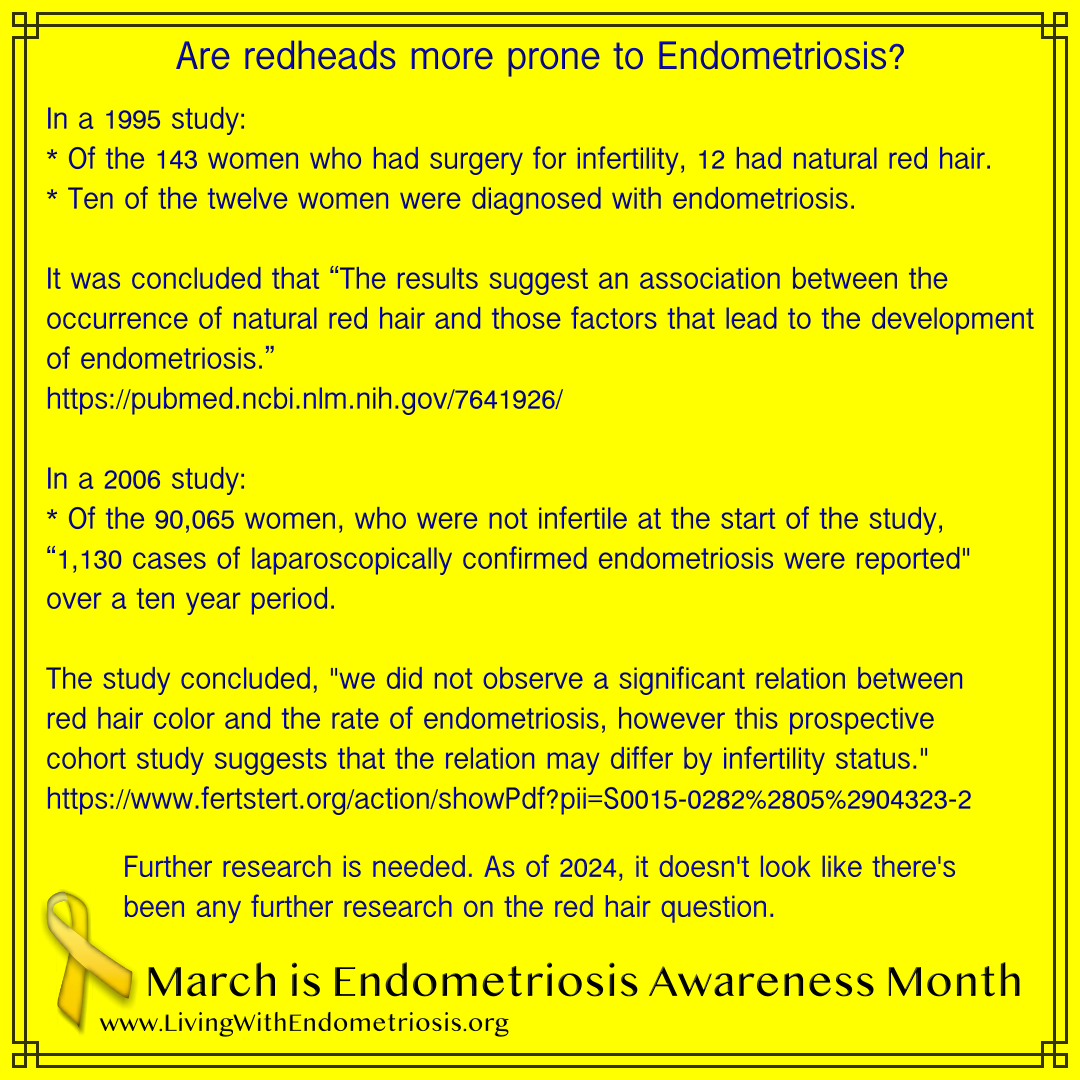
Back in 1995, there was a study to determine whether infertile red-headed women have an increased predisposition towards endometriosis. They studied 143 women having laparoscopy and laparotomy for infertility. Of the 143 women who had the surgery, 12 had natural red hair, and 10 of those 12 women were found to have endometriosis. That’s 83% of the redheaded population in that study.
In contrast, only 55 out of 131 non redheaded women (42%) were found to have endometriosis. So, in that study in 1995, it was concluded that “The results suggest an association between the occurrence of natural red hair and those factors that lead to the development of endometriosis.”

One year later, another study came out, to reopen that case and study it again. In this much larger study, 90,065 women, “who had never been diagnosed with endometriosis, infertility, or cancer” made up the baseline and were followed for the next ten years. The study was published in 2006, showing that in those ten years, “1,130 cases of laparoscopically confirmed endometriosis were reported among women with no past infertility.”

According to endometriosis.org, who reported on the study:

“Red hair colour was not tied to endometriosis in the overall analysis, which accounted for a variety of factors, such as parity (the number of times a woman has given birth) and body mass index. However, there was a suggestion that red hair colour slightly increased the risk of endometriosis among women who had never been infertile, but decreased the risk among those who were infertile.

“Further investigation into the potential linkage between red hair colour and coagulation or immune dysfunction may explain the observed difference in the association between hair colour and endometriosis with concurrent infertility vs. endometriosis without infertility,” the authors conclude.”

AddThis Social Bookmark Button

Fact or Myth? Surgeons will tell you that Endometriosis can be found in unlikely places such the lungs, just to scare you into getting surgery.

March 27th, 2009 steph Posted in Endometriosis Awareness | 1 Comment »

Myth!

Endometriosis HAS actually been found in the lungs! It is still considered uncommon, but there is research dating to the 1960s to prove that endometriosis does in fact occur in the lungs.

Dr. Joseph W. Krotec and RN Sharon Perkins write in Endometriosis for Dummies:

“Diagnosing endometriosis in the lungs, or thoracic endometriosis, requires an inquiring mind. Even if you know you have endometriosis elsewhere, you may think that relating it to your lung problems is too far fetched. Thoracic endometriosis can cause many different symptoms, all seemingly unrelated to your pelvis. But suspecting thoracic endometriosis is the first step to diagnosing it, and you may be more likely to make the connection than your doctor, especially after reading this book.” (Read more on pages 110-112).

See also the Ask Dr. Cook Archives, from notable endometriosis specialist and surgeon Dr. Andrew Cook, whereby he addresses the endo in the lungs question.

AddThis Social Bookmark Button

Fact or Myth? Endometriosis is a very rare disease.

March 26th, 2009 steph Posted in Endometriosis Awareness | No Comments »

Myth!

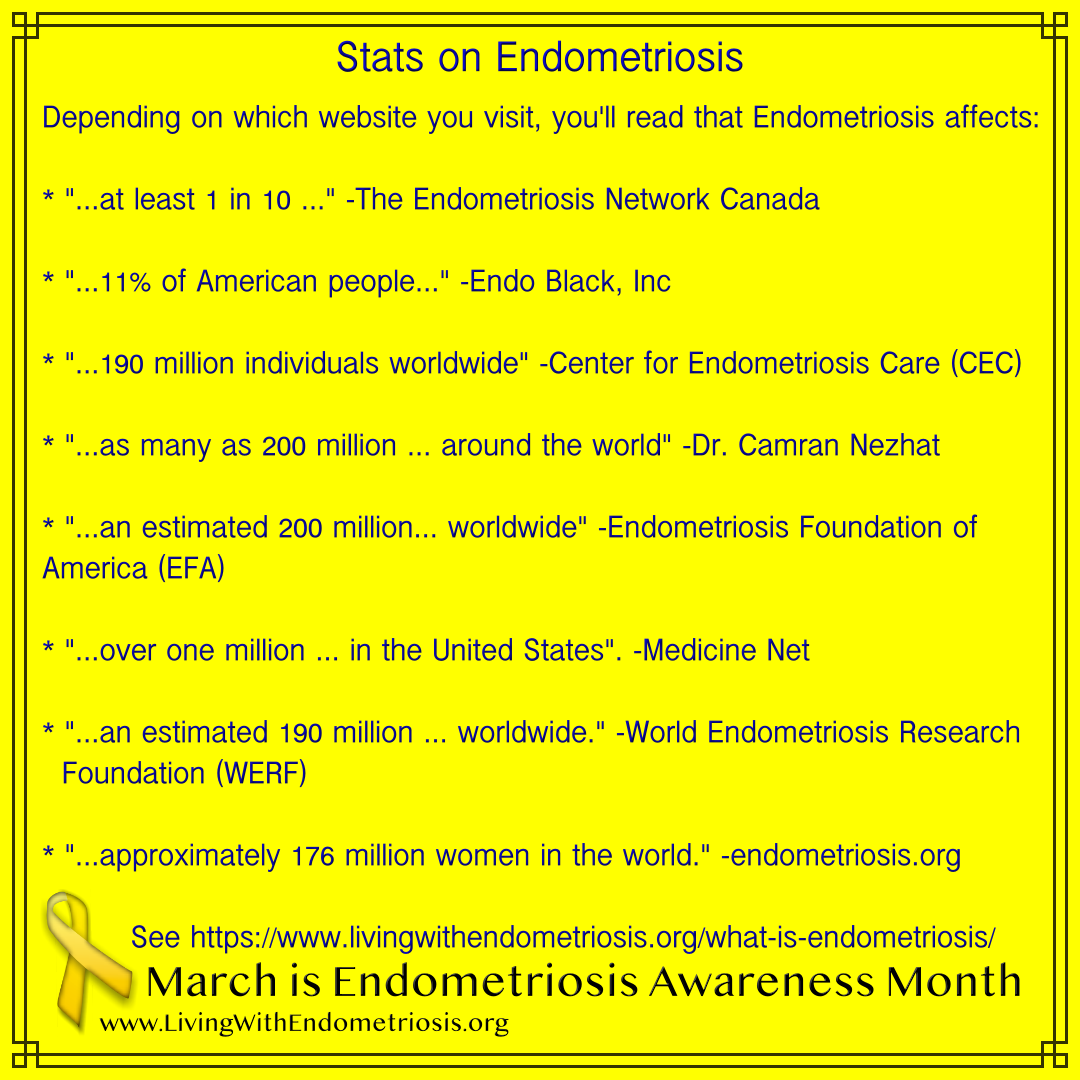
“Endometriosis is one of the most common gynecological diseases, affecting more than 5.5 million women in North America alone.” - The National Institute of Child Health and Human Development (NICHD).

“It is estimated that between 2 percent and 10 percent of American women - or 5.5 million women and girls - of childbearing age have endometriosis. This makes endometriosis more common than AIDS and more common than cancer. Endometriosis is one of the three major causes of female infertility.” - Ohio State University Medical Center.

“Endometriosis is a painful, chronic disease that affects 5 1/2 million women and girls in the USA and Canada, and millions more worldwide.” - The Endometriosis Association.

“Endometriosis affects a staggering 70+ million women and girls worldwide, and there is no definitive cure.” - The Endometriosis Research Center (ERC).

This begs the question, if endometriosis is so prevalent, then why is it still so hidden and misunderstood?

Dr. Joseph W. Krotec and RN Sharon Perkins write in Endometriosis for Dummies: “Cultural norms in some countries discourage women from complaining about pain, especially pain related to the reproductive system.”
They also write, ““Even doctors used to believe that endometriosis was a psychological disease. The prevailing attitude was that, if you just stopped thinking about yourself all the time, all the pain would disappear. Some doctors actually believed that a woman’s positive attitude would make the pain go away. Unfortunately, some professionals still use this rationale today.

“Although a positive attitude is certainly good to have throughout your life, you probably know that attitude doesn’t decrease your endometriosis one bit. Endometriosis isn’t just in your head (although it can be; endometriosis has been found in the brain! See Chapter 6 for more info) — it’s in your pelvis, and it hurts.”

This is why I’m focusing on the myths of endometriosis for Endometriosis Awareness Month in March, 2009 - because this illness is still so very misunderstood, and too taboo to talk about, because it deals with women’s reproductive systems. This has GOT to change if we are to get humane care and promise for a cure.

AddThis Social Bookmark Button

Fact or Myth? Endometriosis is cancerous.

March 25th, 2009 steph Posted in Endometriosis Awareness | No Comments »

So far, a myth.

At this time, it does not appear that Endometriosis is cancerous. Women’s Health U.K. puts it very well:

“Endometriosis is often compared to cancers that affect the female reproductive system, such as ovarian cancer and uterine cancer. This is because both endometriosis and reproductive cancers are characterized by cell invasion and abnormal cell growths. However, endometriosis is not cancer, and the growths associated with endometriosis are benign.

“Endometriosis is characterized by the growth of normal tissue that is usually found in the lining of the uterus, known as endometrial tissue, on the outside of the uterus or on nearby reproductive organs. Endometriosis is a medical condition that features symptoms that may be similar to those of cervical, ovarian, and uterine cancer symptoms, and for this reason the conditions are often linked. Endometriosis does not lead to cancer; however, some medical research suggests that endometriosis may slightly increase the risks of cancer in women.”

A research study out of Huddinge University Hospital in Stockholm, Sweden found that women with Endometriosis are more at risk for developing certain types of cancers than women who do not have Endometriosis. It is important to note that whether or not one has endometriosis, there is a general risk throughout life of developing a cancer. The types of cancers that women with endometriosis are more likely to develop over other cancers are:

  • Ovarian cancer - roughly 50% increase
  • Endocrine cancer - about 30% increase
  • Non-Hodgkin’s lymphoma - about 25% increase
  • Brain tumour - approximately 20% increase

*** Note that in this study, the risk of cervical cancer fell by roughly 30%

Women’s Health U.K. goes on to say:

“the increase in risk is small, and is especially so when considering some of the low risks of developing certain types of ovarian and uterine cancers in the population as a whole.

“Breast cancer, thyroid cancer, and non-Hodgkin’s lymphoma are associated with non-ovarian endometriosis, while a slight increase in the risk of developing ovarian cancer is associated with ovarian endometriosis. Women who have undergone a hysterectomy as part of endometriosis treatment were not found to be at the same increased risk of developing cancer.

“It is important to keep in mind that the connection between endometriosis and cancer is not well understood, and requires further medical research.”

AddThis Social Bookmark Button

Fact or Myth? The more severe the Endometriosis, the more severe the pain.

March 24th, 2009 steph Posted in Endometriosis Awareness | No Comments »

The answer is, “not always.”

It depends on where the Endometriosis is found and how each woman reacts to the pain. My friend had less Endometriosis than me but was bedridden and on disability for a year until her surgery, whereas I am high functioning at stage III until menses, then I’m bedridden for up to four days.

MainLineFertility.com writes:

“Not every woman who experiences painful periods has endometriosis. Moreover, some patients with endometriosis have no pain with their periods. It is a puzzling feature of endometriosis that the pain it causes is not always in proportion to the amount of endometriosis tissue present in the pelvis.”

MedScape.com writes:

“The relationship between pain and the stage and site of endometriosis is controversial. Subjects with advanced disease may have little discomfort, whereas women with minimal or mild endometriosis may present with incapacitating pain.

“Some reports show a correlation between the severity of dysmenorrhea and the stage of endometriosis.[48,49] Yet, observations to the contrary, revealing no association between the stage of endometriosis and the severity of dysmenorrhea as well as nonmenstrual pelvic pain, have also been published.[44,47,50]

“Perper et al[51] observed that the intensity of dysmenorrhea was related to the number of endometrial implants but not to the stage of the disease. However, this finding was contradicted by Muzii et al,[49] who reported a lack of correlation between pain severity and the number as well as the type (typical “black” and atypical “fresh/clear”) of endometriotic lesions.

“Evidence regarding the association between the intensity of pain and morphologic features of the endometriotic implants is inconclusive and contradictory.[44,49,52-54]

“Some data indicate that endometriosis-associated pain persists throughout the reproductive years and that endometriosis stage is directly related to the persistence of pain.[55] Furthermore, deeply infiltrating endometriosis is strongly correlated with pelvic pain and the degree of pain is related to the depth and the volume of infiltration.[47,56,57]

“In a multicenter cross-sectional observational study of 469 women with surgically diagnosed endometriosis and pain symptoms (>6 months), rectovaginal septum endometriosis was associated with more frequent dyspareunia; however, the statistical significance of this finding was borderline.[44] The same study found no significant correlation between stage and site of endometriosis and severity of dysmenorrhea, nonmenstrual pain, and dyspareunia.”

AddThis Social Bookmark Button